By Best Baby Picks Daily • July 20, 2026 • Contains affiliate links
Affiliate Disclosure: As an Amazon Associate, we earn from qualifying purchases. Clicking our links costs you nothing extra and helps us keep reviewing products for free.
Music toys serve a critical developmental function in early childhood—they engage multiple brain regions simultaneously, strengthen auditory processing, improve fine and gross motor control, and support emotional regulation. However, not all music toys are created equal. The market offers three distinct approaches: traditional Montessori-aligned instruments, sensory-rich toys with varied textures and tones, and specially designed autism-friendly options that prioritize communication support and regulated sensory input.
When selecting music toys for early childhood development, prioritize options with adjustable volume controls and multiple sensory modes so you can customize stimulation levels for your child's individual needs and sensory processing preferences. This flexibility ensures the toy remains engaging without becoming overwhelming, which is especially important for children with autism or sensory sensitivities who may need gentler auditory input.
This guide compares these approaches head-to-head, examining the specific developmental benefits, design philosophies, and use cases for each. Whether you're shopping for a typically developing child, a child with sensory processing differences, or one with autism or speech delays, understanding the differences between these categories will help you make a more intentional purchase.
Montessori-Aligned Music Toys
Montessori music toys emphasize self-directed exploration and independent learning at the child's own pace. They typically feature natural materials (wood), non-toxic finishes, and clear, pleasant tones that encourage repeated engagement without overwhelming the child. Design focuses on cause-and-effect relationships and open-ended play rather than pre-programmed sounds or lights.
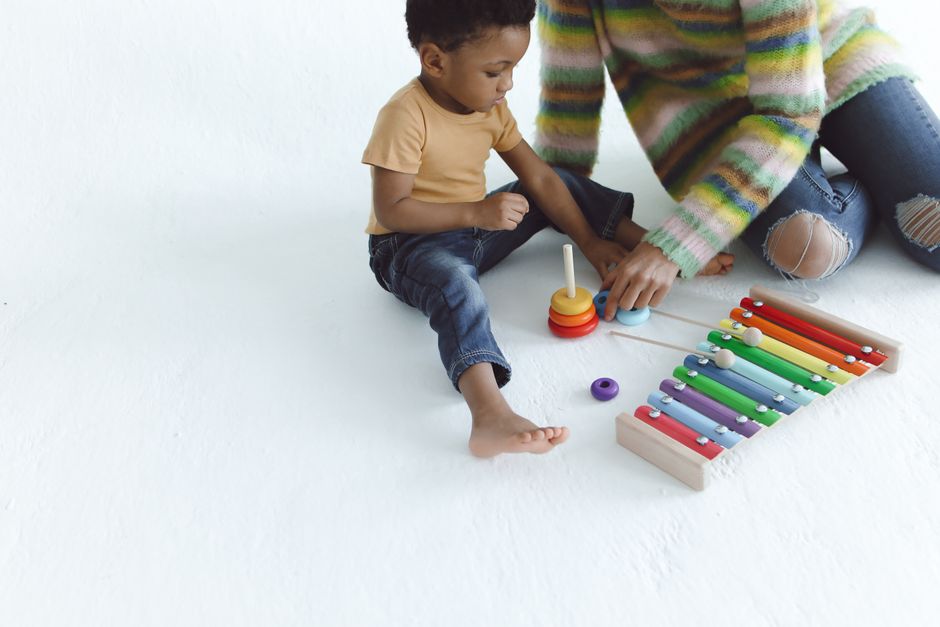
Examples include wooden xylophones with color-coded keys, simple percussion instruments with ergonomic handles, and maraca-style shakers. The philosophy prioritizes quality of construction and sound over quantity of features, encouraging children to develop auditory discrimination and rhythm awareness through exploration.
Best for: Parents and educators seeking intentional, screen-free play tools; children ages 6 months–3 years; classrooms using Montessori methodology; families prioritizing natural materials and durability over novelty.
Sensory-rich music toys incorporate diverse textures, varied sound qualities, and visual feedback to engage children with different sensory preferences. These might include maracas with textured grips, drums with resonant (not tinny) tones, and instruments with color-coding or shape-differentiation. The goal is stimulating multiple sensory modalities—touch, hearing, and sight—simultaneously.
This category bridges traditional and specialized design, offering more variety than strict Montessori instruments while avoiding overstimulation through careful sound selection and material quality. Sensory variety supports children with hypo- or hypersensitivity to tactile or auditory input.
Best for: Children with sensory processing differences; early childhood settings serving mixed developmental needs; children who need additional tactile or auditory engagement; ages 6 months–4 years.
Autism-Friendly & Special Needs Music Toys
Designed specifically for children with autism, developmental delays, or speech and language disorders, these instruments prioritize communication support, regulated sensory input, and therapeutic benefit. They often include features that support Alternative and Augmentative Communication (AAC)—bridging the gap between musical expression and verbal/non-verbal communication pathways.
Sound selection is critical in this category: instruments are chosen or designed to provide calming or organizing sensory input without harsh, unpredictable, or overwhelming tones. Some options include communication-friendly busy boards with musical elements, which layer multiple developmental benefits (fine motor, cause-and-effect, sound exploration, and communication scaffolding) into one tool.
Best for: Children with autism spectrum disorder; children with speech/language delays; those with sensory regulation challenges; non-verbal or minimally verbal children; children using AAC devices; ages 12 months–5+ years.
Hybrid Busy Boards with Sound Elements
Busy boards that integrate musical elements (rather than standalone instruments) combine fine motor skill development, cause-and-effect learning, and auditory exploration in one tool. These typically include buttons, switches, or activators that produce sound or music when manipulated, scaffolding the connection between action and result.
Particularly effective for children with motor planning challenges or those who benefit from multi-sensory integration. Less portable than individual instruments but more developmentally dense, offering extended engagement through layered learning opportunities.
Best for: Children who benefit from integrated, multi-skill learning; those with motor planning challenges; children who need structured cause-and-effect practice; mixed-ability early childhood settings.
Pros & Cons
Pros
✓ Music-based play activates neural pathways for language processing, memory, and emotional expression simultaneously—far more developmentally efficient than passive toys.
✓ Montessori and sensory instruments support self-directed learning, allowing children to explore at their own developmental pace without adult instruction requirements.
✓ Autism-friendly and special needs options provide bridges to communication and self-regulation for children who struggle with verbal expression—offering therapeutic benefit beyond entertainment.
✓ Quality construction (wood, non-toxic finishes, clear tones) ensures durability and safety while avoiding cheap materials that produce tinny, discouraging sounds that inhibit repeated engagement.
✓ Sensory variety and texture-rich options accommodate children with hypo- and hypersensitivity, making musical play accessible to a wider range of developmental profiles.
Cons
✗ Montessori instruments often cost more than mass-market alternatives due to material quality and intentional design, though they justify longevity and educational value.
✗ Autism-friendly and specialized music toys are less widely available than generic options, requiring more deliberate sourcing and potentially limiting choice compared to mainstream toy retailers.
✗ Sound-producing toys can overstimulate children with auditory sensitivity; careful selection by sensory profile is necessary rather than one-size-fits-all purchasing.
✗ Busy boards with sound elements take up more physical space than individual instruments, making them less portable for travel or small living situations.
Our Verdict
Choose Montessori-aligned instruments if: You're prioritizing intentional, screen-free exploration in a low-distraction environment. These excel in Montessori classrooms and for families seeking durable, natural tools that encourage auditory discrimination and rhythm awareness. Best for typically developing children ages 6 months–3 years with access to guided exploration.
Choose sensory-rich instruments if: Your child has varying sensory preferences or mild sensory processing differences but doesn't require specialized communication support. This middle-ground category offers more developmental flexibility than strict Montessori while maintaining quality standards. Works well in mixed-ability early childhood settings.
Choose autism-friendly and special needs options if: Your child has autism, significant speech/language delays, or sensory regulation challenges. These tools serve a therapeutic function beyond play, scaffolding communication pathways and providing structured sensory input calibrated to individual needs. This is the only category with research-backed benefit for non-verbal and minimally verbal children. The therapeutic value justifies higher cost and sourcing effort.
Choose hybrid busy boards if: You need one tool that layers multiple developmental domains (fine motor, cause-and-effect, auditory exploration, communication scaffolding). These are particularly effective for children with motor planning challenges or those who benefit from integrated, multi-skill learning but less portable than individual instruments.
Reality check: Most families benefit from combining approaches—perhaps a small collection of Montessori wooden instruments for exploration, plus a sensory-rich maraca or two for varied tactile engagement, and (if relevant) a specialized busy board for communication support. Quality matters more than quantity; three well-chosen instruments outperform a shelf of cheap, tinny toys.
Frequently Asked Questions
At what age do music toys become developmentally useful?
From birth onwards. Infants benefit from sound exploration starting around 4–6 months. Montessori and sensory instruments are appropriate from 6 months; autism-friendly communication-based toys can be introduced anytime a child shows interest in cause-and-effect play (typically 8–12 months). There is no upper age limit—music play supports learning through early childhood and beyond.
Why do cheap music toys often feel discouraging to children?
Cheap toys typically produce tinny, unpredictable, or harsh sounds that don't reward repeated exploration. Children quickly learn that manipulating the toy doesn't produce a satisfying result, so they lose interest. Quality instruments with clear, pleasant tones encourage continued engagement and auditory discrimination. For children with sensory sensitivities, poor sound quality can actually cause discomfort or avoidance.
What's the difference between a music toy and a communication tool?
A music toy is primarily designed for exploration and play. A communication tool (like a busy board with sound elements or AAC-integrated instruments) is intentionally designed to bridge the gap between action and expression, particularly for non-verbal or minimally verbal children. The latter serves a therapeutic function beyond entertainment, scaffolding the neurological pathways that support communication development.
Are Montessori music toys worth the higher price?
Yes, if durability and intentional design matter to you. Montessori instruments typically use solid wood, non-toxic finishes, and engineered sound quality that withstands repeated use across multiple children or years. They encourage deeper engagement through self-directed exploration. However, if budget is tight, a single quality instrument (wooden xylophone, clear-sounding drum) beats multiple cheap alternatives. Quality over quantity.
How do I know if a music toy is appropriate for my child's sensory profile?
Observe how your child responds to everyday sounds. If they cover their ears at loud noises or seem distressed by unpredictable sounds, they likely have auditory hypersensitivity—choose instruments with softer, more predictable tones and avoid busy boards with bells or chimes. If they seek out sound and seem under-responsive to audio input, sensory-rich instruments with varied tones will engage them better. For autism-specific sensory profiles, consult toys specifically labeled as autism-friendly, which account for both hypo- and hypersensitivity.
Can music toys help with speech and language development?
Yes. Research consistently shows that early musical engagement strengthens auditory discrimination (the ability to distinguish phonetic differences), which underpins language acquisition. For children with speech delays, music toys can serve as a scaffolding tool—providing an alternative avenue for expression and communication support, particularly when paired with AAC tools or used in conjunction with speech therapy. Music alone doesn't replace speech therapy but complements it effectively.
Our team evaluates baby products for safety, usability, and value so you don't have to. Every recommendation is based on real research: customer reviews, expert opinions, and value for money. Learn more about us →
This post contains affiliate links. We may earn a commission if you purchase through our links at no extra cost to you.